
Applying Through VMCAS?
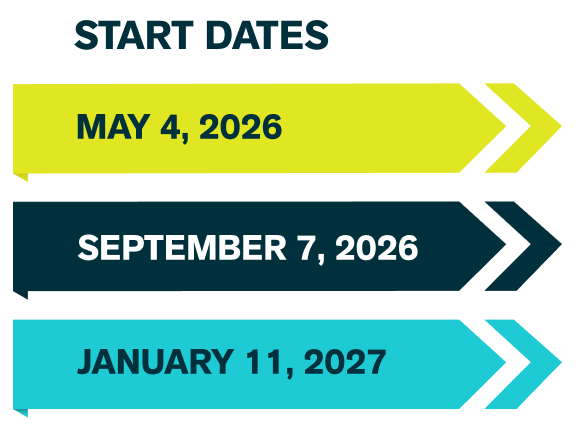
START EARNING YOUR DVM IN JANUARY, MAY, OR SEPTEMBER
Submit your application to Ross Vet through the Veterinary Medical College Application Service (VMCAS)! You can select from our three available start dates in May or September 2026 and January 2027. Alternatively, we also welcome applications directly through our website.
Start Sooner, Finish Sooner
While most students choose to wait until a fall intake, many Ross Vet students take advantage of an early start by enrolling in our January and May semesters.
Combined with our accelerated curriculum, starting at Ross Vet in January allows you to finish up to a year earlier* than waiting and starting in the following September at most U.S. vet schools. Similarly, a May start allows you to finish up to nine months sooner* than starting in the following fall at U.S. schools.
- Graduate as early as September 2029 by starting in our May 2026 semester
*Time frame based on student maintaining continuous enrollment, successfully passing all courses prescribed in the Ross Vet preclinical and clinical curriculum (without failing or repeating any courses), and passing the North American Veterinary Licensing Examination® (NAVLE®). Comparison to U.S. vet schools is based on a traditional 4-year curriculum.


How it Works
AVMA®-ACCREDITED1 3.25 YEAR DVM PROGRAM
Our 3.25 year accelerated DVM curriculum includes ten semesters of learning experiences.
7 SEMESTERS IN ST. KITTS
Your first seven semesters (2.25 years) are spent on campus in St. Kitts completing specifically prescribed coursework.
CLINICAL YEAR AT AN AVMA-ACCREDITED SCHOOL
Your final year of the program will be spent in intense clinical training in one of our 29 AVMA-accredited school affiliates in the U.S., Canada, UK, Ireland, New Zealand, or Australia.
ELIGIBILITY FOR LICENSURE
Upon graduation and passing the North American Veterinary Licensing Examination®, you will be eligible to apply to practice in the U.S., Canada, and Puerto Rico.
on campus
Program

Flexibility
From our three start dates to our Dual-Degree program options, earn your degree(s) your way.

Community
Approachable professors and student clubs provide opportunities to enhance and apply classroom teachings in the real world.

Unique Opportunities
Our location on St. Kitts offers exposure to exotic marine and wildlife for research and learning.
Frequently Asked Questions
A: No. If you have completed and submitted your Ross Vet application with VMCAS, you do not need to apply separately through the Ross Vet website.
A: Yes! It is possible to be accepted into our DVM program as long as you have completed the pre-requisite courses and meet all of the admission requirements.
A: Yes, eligible U.S. citizens and qualified non-citizens may apply for federal student loans through the Federal Direct Loan program.
A: The first seven semesters (2.25 years) for the DVM program take place in St. Kitts. The last three semesters are completed at an AVMA-accredited school or college of veterinary medicine in the U.S., Canada, or abroad.
A: The GRE® is not required to apply to Ross Vet. However, applications that include the GRE, regardless of GRE score, will be given priority in the review process. At Ross Vet, we know there is more to your story than GPA and GRE, and that’s why we take into account each applicant’s unique attributes and experiences in addition to important academic elements.
How will these changes affect current veterinary students?
Students who have taken out loans before July 1, 2026, are generally exempt from the new borrowing limits for up to three academic years or until they complete their program, whichever comes first.
What if my veterinary school’s cost of attendance exceeds these limits?
If your total cost of attendance is higher than the federal loan limits, you may need to look into other ways to cover the difference, such as private loans. Our Office of Student Finance is here to help. Email finaid@rossu.edu to discuss your options and create a plan that fits your financial situation.

“Ross Vet, even though it’s an accelerated program, has a very complete curriculum. We have a lot of international professors from different parts of the world, so we got to learn how medicine is practiced in different parts of the world. And the opportunities to do labs with live animals before we get to clinics was a great opportunity to grow.”
Marielle Yuret, DVM ’24

P.O Box 334 Basseterre St. Kitts West Indies | Phone: +1-869-465-4161 | Admissions (US toll free): 855-ROSS-Vet
Admissions (international): +1-732-509-3042 | Fax: +1-869-465-1203 | VetAdmissions@RossU.edu | Privacy Statement
Academic Catalog | Student Handbook
1Ross University School of Veterinary Medicine confers a Doctor of Veterinary Medicine (DVM) degree, which is accredited by the American Veterinary Medical Association Council on Education (AVMA COE), 1931 N. Meacham Road, Suite 100, Schaumburg, IL 60173, Tel: 800.248.2862. For more information please visit https://www.avma.org/?vc=.
*Not available to residents of Alabama
The AVMA COE uses defined standards to evaluate veterinary medical education programs, including facilities, clinical resources, curriculum, faculty, student outcomes and research programs. The standards are interpreted and applied by the AVMA COE-accredited veterinary medical education programs in relation to its mission.
©2026 Ross University School of Veterinary Medicine. All rights reserved.